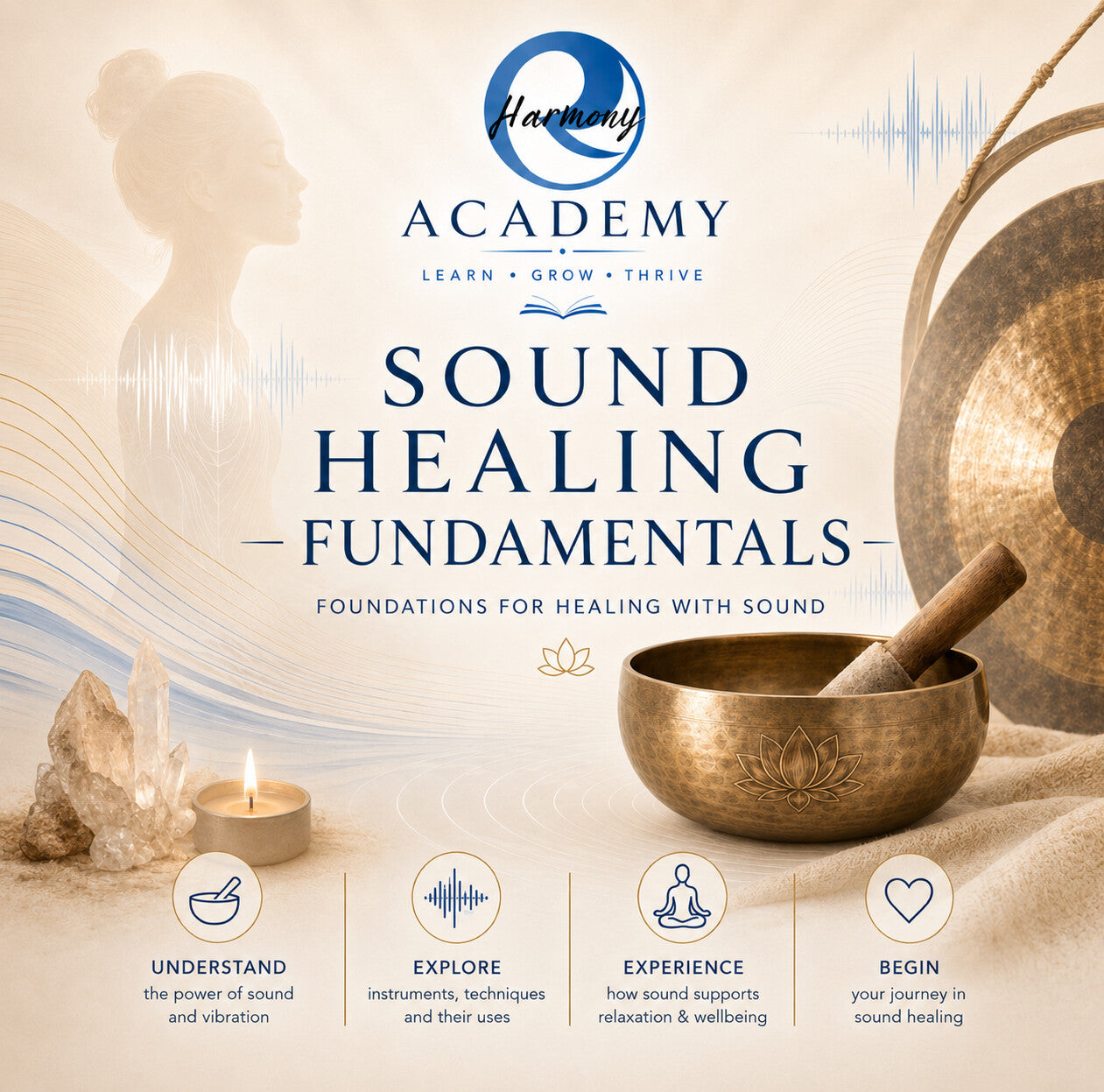

Sound Healing Fundamentals
Access details arrive by email after checkout. Watch on any device, at your own pace.
You do not need to be musical. You need to learn how to listen.
Sound Healing Fundamentals is a filmed tour of more than twenty instruments, taught by someone who will also tell you when to put them down. Nearly five hours, shot in a working sound studio in Limerick, with a collection of gongs, bowls and drums you will probably never see in one room again.
4 hours 44 minutes · 21 lessons · 20+ instruments · Lifetime access
Most sound healing courses show you instruments. This one shows you restraint.
There are plenty of videos that point a camera at a gong and hit it. What is harder to find is someone explaining why the fifth strike ruined the room, why the mallet matters more than the gong, and why the silence after the sound is doing most of the work.
Every lesson follows the same shape: what the instrument is, how it feels, where it belongs in a session, then a demonstration, then time to notice what happened in your own body.
"A sound bath is not a test. You are not trying to achieve something."
What you will actually walk away with
- The ability to tell instruments apart by ear. Tibetan bowls are warm and earthy. Crystal bowls are bright and spacious. After five hours you will hear the difference without being told.
- A buying guide worth more than the course. Real brands, real price tiers and our own opinions. Sacred Forest, Gong Land, Grotta Sonora, Koshi, Zaphir. Also which cheap instruments sound perfectly good, so you do not waste money finding out.
- Technique that changes the sound immediately. Where to strike a gong for depth versus shimmer. Why mallets are keys. How to angle a rain stick instead of flipping it. How to make a stubborn bowl sing.
- Session craft, not just instrument tourism. How to open a session, cover a transition, bring people back into the room, and know when enough is enough.
- Safety you will not get from YouTube. Volume near heads and ears. Why an anxious rhythm can push a nervous system the wrong way. Which techniques need proper anatomy training first.
- Permission to have your own experience. The course opens by dismantling the idea that there is a correct way to receive sound. Falling asleep is not failure.
The full curriculum
Before you begin
-
Everyone Experiences Sound Differently (10 min)
Why two people in the same sound bath report completely different things. Nervous system state, memory, culture and physical sensitivity. Four questions to ask yourself during any session.
Bowls
-
Tibetan Singing Bowls (25 min)
The anatomy of a bowl tone from strike to silence. Why light strikes beat hard ones. Rim singing, and what to do when a bowl refuses to sing. How size, weight and thickness change pitch and sustain. Soft wool, suede and bare wood wands compared. -
Crystal Singing Bowls (20 min)
Frosted, clear and coloured quartz from 5 to 22 inches. How crystal differs from Tibetan. Pairing a large low bowl with a small high bowl. A story about overwhelming clients by playing too loud for too long. -
Crystal Bowl Listening Track (5 min, audio)
No narration. Five minutes of crystal bowls to practise listening with, or to keep and use.
Gongs
-
Gongs (29 min)
Chau, wind, symphonic, mirror, harp and Deep Earth gongs, from a 15 inch handheld up to a 60 inch giant. Why a gong makes a field rather than a note. Mallets as keys. Centre for depth, outer edge for shimmer. Why loudness is almost never the answer.
Rhythm and pulse
-
Drums (20 min)
Shamanic frame drums, 50cm and 60cm Viking drums, a handmade mushroom drum and a 1.4 metre mother drum. A live demonstration of a calm heartbeat rhythm against an anxious one, and what each does to a room. Simple counted patterns for people who think they have no rhythm. -
Shamanic Drum Journey (15 min, audio)
A short introduction, then ten minutes of unbroken drumming. Headphones recommended. Yours to keep and use. -
Ocean Drum (2 min, audio)
A short pure demonstration with no narration over it.
The bright family
-
Chimes (9 min)
Bar chimes, Koshi chimes by element, Zaphir chimes and swinging hand tubes. Where bright sounds belong in a session. Which budget chimes sound genuinely good. -
Tingsha Meditation (9 min)
One tone that cuts through mental noise. How tingsha open, close and mark a session. Includes a full guided breath and sound meditation using the tingsha as an anchor. -
Crystal Harp (12 min)
Two harps in the key of C compared side by side, one branded and one budget. Striking the tubes versus drawing the tone out with wet hands. Layering the harp with bowls and a rain pillar. -
Crystal Pyramids (10 min)
Six, ten, twelve and fourteen inch pyramids. Why the small ones are delicate and the large ones hang in the air. Using them as brief detail rather than a feature. -
Calix (10 min)
Five Calix by Somni Sounds, each with two nodes tuned in fifths. How the tone ducks in and out as you move it. Striking away from the head and bringing it closer.
Texture and atmosphere
-
Rain Pillars and Rain Sticks (12 min)
Pillars running 4, 8, 12 and 22 minutes, and rain sticks up to 1.5 metres. Why you angle and turn a stick rather than flip it. Moving a pillar around the room to change how listeners sit inside the sound. -
Pangi and Shakers (14 min)
Seed, shell, nut and wood shakers, plus the panji bar chime. How to hold a shaker in your drum hand and play both. Why texture works until it becomes a distraction. -
Waterphone (9 min)
A Mega Bass waterphone with a litre of water sealed inside, played with a bow. Why it splits a room, and why it should be a moment rather than a background. -
Monochord (6 min)
Where the name comes from, the Pythagorean origin, and why a wall of near-identical strings creates a drone dense with overtones. -
Bits and Bobs (25 min)
The curiosity cabinet. Thunder drums, sound frogs, bird whistles, buffalo horn, kalimbas, tuned wah-wah tubes, bass resonators, a pocket gong and a didgesax. Also why you should keep blankets in the room before you play a thunder drum.
Breath and voice
-
Flutes (13 min)
Drone flutes in E, A and G. Why a flute carries your breath into the room after the heavy instruments. PVC as a cheap entry point against handcrafted wood. The same phrase played dry, then with reverb. -
Voice and Shruti Box (21 min)
Using a drone to give your voice something to rest on. Where each vowel sits in the body. Humming to lengthen the exhale, then toning. Includes safety guidance and a guided practice. No singing ability required.
Closing
-
A Drum Is Not Just a Drum (8 min)
Tone, overtones and harmonics. Sound as vibration you feel rather than hear. Why the nervous system is always listening. Ends with a listening exercise to work out which instruments felt grounding, bright or challenging for you.
What comes with it
- The Sound Healing Instrument Guide. Dozens of instruments from different traditions, with what they are and where they come from. Yours to keep.
- A printable Listening Journal. For tracking what you notice, which is the whole point of the course.
- Three listening tracks. A five minute crystal bowl track, a ten minute shamanic drum journey and an ocean drum piece. Usable long after the course ends.
- Lifetime access. Watch in any order, at any pace, as many times as you like.
Who is teaching this
Éanna Healy runs Revival Harmony in Limerick. He studied Music Production and Radio long before he heard the term sound healing, then trained in sound medicine, gong mastery, and shamanic and advanced shamanic practice.
What makes the course worth watching is that he is still learning himself. He tells you he quit playing flute for years because nobody said anything about it. He tells you he cancelled a voice course because he was afraid of it. He tells you he cannot circular breathe on the didgeridoo yet. He tells you he ran his first sound baths behind a pre-recorded meditation because he could not speak to a room.
On-body bowl placement and deep gong work are taught in the in-person training at Revival Harmony, where they can be practised hands-on with guidance.
Where this takes you next
A proper map of the whole landscape.
Twenty plus instruments, demonstrated properly, so that when you decide where to go deeper you are choosing rather than guessing.
Some people take this as their first step before training with us in person. Others take it because they want to understand what they are hearing, and to play well at home. Both are good reasons.
Planning to train with us in person?
You will never pay twice for the same material.
Finish the course, then email your order confirmation to harmony@revival.ie. If you go on to book Level One with Revival Harmony within six months, we will take the full €97 off your Level One fee.
Already booked Level One with us? Sound Healing Fundamentals is included in your training. Email harmony@revival.ie and we will send your access.
No musical experience or instruments are required, just an open mind and a willingness to explore.
Not sure which one to choose? Call 061 424 765, WhatsApp 089 985 1601 or email harmony@revival.ie and we will point you the right way.
You can also book a 90 minute consultation in the studio and play instruments before you decide. The €200 fee is credited against anything you buy on the day.

Choose options